Tuesday, 16 June 2015

Cheeky chicken wings


I love these at lunchtime alongside a bowl of soup or salad.  The kids devour them (alongside a portion of greens or peas).  

They are super easy and having tried them you will never want to have a shop bought one again! The list of ingredients is quite long but is really just a case of making a spice mix and you could always mulitply the amounts and make up a jar.  This is a bit of a store cupboard recipe so it uses all dried spices rather than fresh. 

These also taste great cold and can be made in advance and used for packed lunches / picnics etc.


Ingredients

1/2 tsp of garlic powder
1/4 tsp cinnamon
1 tsp paprika 
1/2 tsp oregano
1/2 tsp thyme
1/4 tsp rosemary 
1/4 tsp salt
1/8 tsp ground black pepper 
1 kg of chicken wings 


Method

Preheat the oven to 180c fan / 200c 
Mix together all the spices 
Rub the spice mix all over the chicken wings 
Place the chicken wings on a metal rack over a baking tray so they can get crispy all over
Cook for twenty minutes and turn 
Cook for another twenty minutes and check to see if they are cooked through 

Thursday, 11 June 2015

Think you can eat clean by checking food labels? Think again


‘The finest trick of the the Devil is to persuade you that he doesn’t exist’
 (Charles Baudelaire)

Is the food industry guilty of a similar trick with their ‘clean label campaign? In Joanna Blythman’s new book, ‘Swallow This’ (a read that is fascinating and scary in equal measure) she looks at whether the food industry is improving or simply rebranding.

When consumers became fidgety about e-numbers, additives and food colourings the industry decided they needed to react to this pressure.  But have they really improved our food?  On the face of it yes.  Shoppers are reassured by ‘no artificial colours or flavourings’, ‘no added sugar’ etc.  Even the most conscientious consumer who reads the small print on the back will no longer find a long list of e-numbers or the dreaded trans fats listed, instead there is the more palatable ‘modified starch’, ‘natural colourings’ etc.

However what is behind this change, according to Joanna, is not a more natural approach to food production but closer to a PR exercise. In reality there is now just a different set of industrially produced ingredients, processing aids and enzymes that are potentially no safer than the E-numbers that they replaced.  Manufacturers do not appear interested in the nutritional qualities of the food they produce.  Everything is about initial look or taste, of ‘appearing natural’ or ‘fresh-like’. 

Even if there is nothing intrinsically wrong with using these ingredients their existence is to make the process cheaper and means there is lot less of real and nutritious ingredients like butter, nuts, flour, dairy and meat. Processed food is not ‘food’ anymore but  ‘complex constructions of high-tech ingredients’.  

Unfortunately there is no reassurance for those of us who like to think we have escaped the problem by avoiding the obviously heavily processed foods such as cheap biscuits and cakes, ready meals and packet sauces.  Joanna’s research covers food that even the most diligent parent would have in their shopping basket – bread, premium yoghurts, frozen vegetables, chicken, sliced meats and ready prepared fruit and vegetables.

‘You might even boycott the most obvious forms of nutritionally compromised, blatantly degraded offerings, and yet you will still find it hard to avoid the 6,000 food additives – flavourings, glazing agents, improvers, anti-caking agents, solvents, preservatives, colourings, acids, emulsifiers, releasing agents, antioxidants, thickeners, bleaching agents, sweeteners, chelators – and the undisclosed ‘processing aids’, that are routinely employed behind the scenes of contemporary food manufacture.’

Take yoghurts for example.   Low fat yoghurts are incredibly popular with families but how does a manufacturer make low fat yoghurt have the creamy goodness we associate with full fat food?  Step forward ‘modified starch’.  It sounds innocent enough – we know there is starch in rice and potatoes? However the industrial process used to create this ingredient mean it is far removed from any starch you would find in natural food.  It is a manufacturer’s dream - a cheap, bland ingredient that sticks to the inside of your mouth tricking your brain into thinking you have ingested fat.   (I happened to mention it to a friend whose husband works in the food industry – little did I know that he was a starch technologist and she confirmed it is a growing area of research precisely because it can be a great ‘filler’ in so many foods)

What surprised me the most was what manufacturers are allowed to use as a ‘processing aid’ and not include on the label. How often have you picked up some ready prepped vegetables or a fruit salad, assuming that they are in their natural state?  Would you think that they had been treated with enzymes to look fresher and firmer in their pack?  

  How about when you consciously avoid all the pre-packaged biscuits and decide instead to treat yourself to something from an in-store bakery, would you dream that it might have been pre-prepared months before and then left frozen on shelf waiting to be finished off on site?

  So why isn’t there more transparency in the industry?  During a Radio 4 discussion Alice Cadman from Leatherhead Food Research was asked about the processes involved in food production and here is what she thinks of consumer’s concerns:

  “...it’s the food industry’s job to make high quality very safe food and it’s a complicated area…I wouldn’t expect consumers to understand the ingredients, I wouldn’t expect consumers to understand the regulatory framework but I would expect them to trust the people who are making the food for them because that’s what they do”

  Hearing that I didn’t feel reassured I felt patronised. Unfortunately for the food industry the age of people trusting large institutions to serve their interests is long gone!

We mustn’t fall into the trap of thinking we shouldn’t ask tough questions about the food industry because we are not clever or scientific enough to understand the answer.  The whole point of regulatory bodies and labels should be to make information accessible. We also shouldn’t be made to feel like we are being ‘difficult’ for wanting to know what is in our food! 


More on this subject and practical advice for families wanting to eat clean in further posts, coming next week.  

In the meantime check out Joanna’s book, which is on Amazon (http://www.amazon.co.uk/dp/0007548338) and in the shops (possibly not being stocked at supermarkets though!!)


Monday, 18 May 2015

Wibbly wobbly jelly


The hardest part of making this dish is sourcing the gelatine sheets!  I buy mine from The Real Food Company in Crewe.  You can also source it from Amazon and even the baking sections of supermarkets (although I would plump for grass fed or organic gelatine, especially if you are making this regularly). 
Making your own jelly is incredibly simple and means you can create something that is yummy but also nutritious and sugar free!  The benefits of gelatine are numerous - it helps to heal the lining of the stomach and is great for nail and hair health. 
I like to use raspberries but any soft fruit will work. If you wish to use pineapple, kiwi, melon or papaya they will need to be cooked into a purée or the enzymes they contain will break down the gelatine. 
I use organic frozen fruit as it is cheaper but fresh would work also. 

If you want to change the quantities below keep a rough ratio of 125 ml liquid to a sheet of gelatine for a soft jelly (served in glass) or 100ml liquid to a sheet of gelatin for a firm jelly that you can turn out of a mould. 


Ingredients 

3 sheets of gelatine 
300g frozen fruit 
2 tbsp of honey (more if very sweet toothed!) 


Method

- Place the fruit in a pan with enough water to cover the base 
- Heat gently so that the fruit breaks down - you can help the process with a potato masher! 
- Once the fruit had disintegrated sieve the mixture into a bowl or jug (use a fine sieve so the seeds do not fall through). You can use the back if a spoon to push the mixture down and extract more liquid.
- Add the honey and stir thoroughly 
- Add filtered water until you have 400ml of mixture 
- Place the gelatine sheets in a large shallow dish and cover with water.  Ensure the sheets are kept separate so they can soften properly 
(During this time return the fruit liquid to the pan and heat very gently so that it stays warm as the liquid needs to be over 35 degrees for the mixture to set) 
- After 5 minutes remove the sheets, squeeze them to remove any excess water and add to the mixture 
- Stir thoroughly ensuring the sheets have fully dissolved 
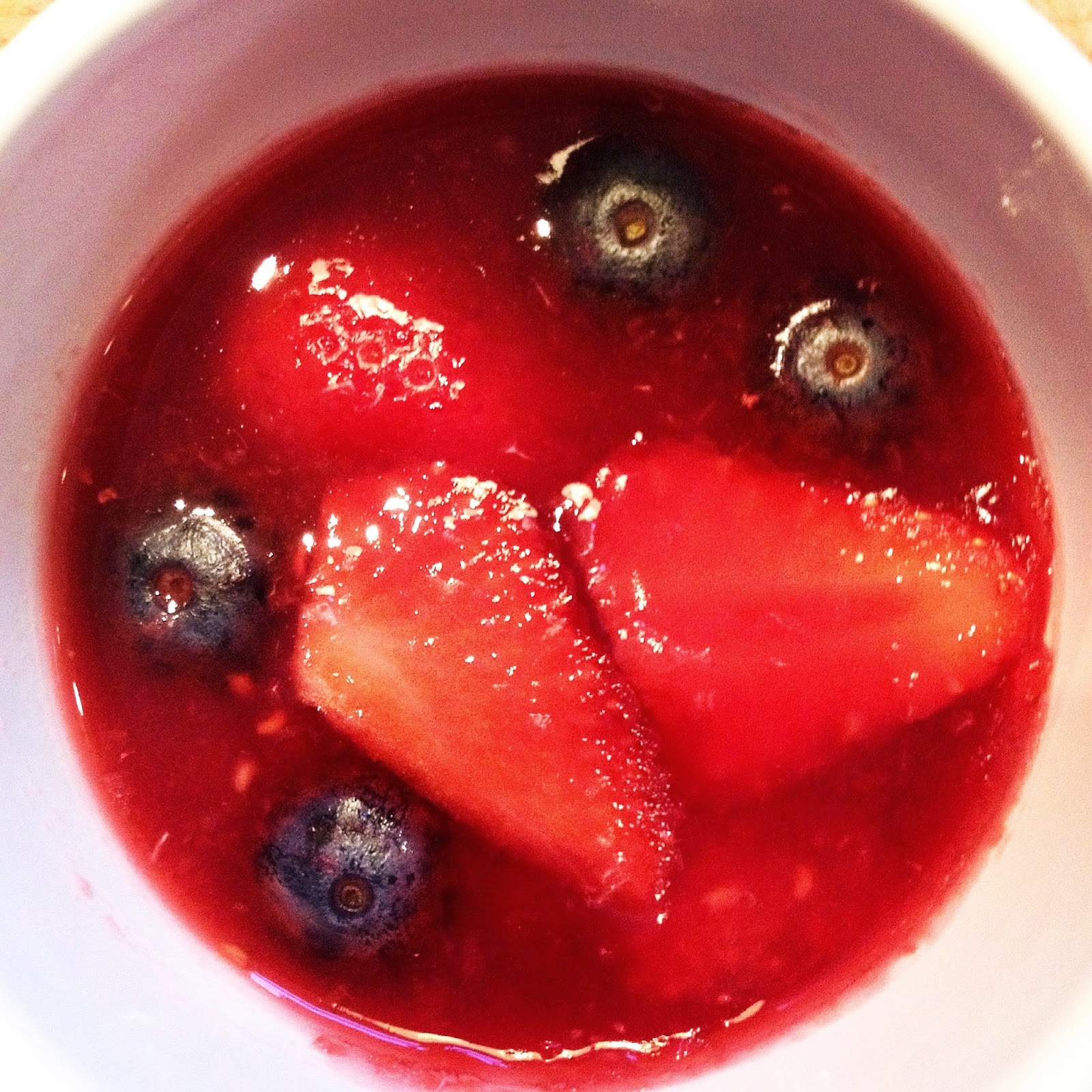
- Pour the mixture into serving glasses (I also like to add a few slices of strawberry or blueberries)
-Refrigerate for a couple of hours until set.


Friday, 1 May 2015

Old skool sausage pasta


This is a dish that reminds me of my husband and I's uni days.  Now though the pasta is gluten free, the sausages are better quality and the table is strewn with toys, not overflowing ashtrays and wine bottles! (Well to be fair there is still wine around!) 

This is a winner for us because my daughter who won't eat sausages on their own enjoys them in this sauce. My son, who would eat sausages for every meal is happy to gobble up the sauce, red pepper and all! 

I make up my own Italian mixed herbs by mixing together equal amounts of dried oregano, thyme, basil, sage and rosemary.  

We use free range or organic all meat sausages from Graig Farm, Devon Rose or Roaming Rooster but any good quality plain banger will do (avoid herbs that will fight with the Italian seasoning!) 

I always make at least two family sized portions at once - simply double up the ingredients below. 

We serve this with brown rice or buckwheat pasta and some buttered green beans on the side. It would also work well on its own with a green salad. 


Ingredients 

1 packet of sausages 
1 medium onion, chopped 
1 red pepper, deseeded and chopped into small pieces 
2 cloves of garlic, crushed 
1 tsp of Italian seasoning 
Olive oil / ghee / lard or beef dripping for cooking 
1/3-1/2 bottle (approx 300ml) of organic passata 
Glass of red wine (optional) 


Method 

- Heat a tbsp of oil/fat  in a large pan and add the sausages, cooking for a couple of minutes before turning over so they are browned all over. (If you are cooking more than one portion it is best to cook the sausages in batches)  Remove the sausages from the pan and set aside.
- Lower the heat, add more oil if necessary and add in the onion and red pepper, cooking gently for around ten minutes until soft. During this time cut the sausages into small chunks (around 6 per sausage). I find it easiest to do this with scissors 
- Add the garlic to the pan, stirring frequently to prevent it burning and becoming bitter. After a couple of minutes add the sausage pieces back into the pan and increase the heat 
- Add in the passata, wine and herbs. (If you are adding in wine only use 1/3 of a bottle) 
- Season generously with salt and pepper 
- Once it reaches a vigorous simmer reduce the heat so it is simmering gently and cover. 
- Simmer for around 40 minutes or until it reaches the desired consistency, stirring occasionally to prevent sticking.


Wednesday, 22 April 2015

Buckwheat granola (or cereal to us English folks!)


In the old days when my children ate cereal I would diligently read the side of the box - who wouldn't be reassured to find such a long list of vitamins and minerals in just one product, that children actually enjoy eating?  However there is now debate about whether the body can actually absorb any of these synthetic vitamins.  There is concern that the 'extrusion' process used to make cereal not only removes nutrients from the grain but also denatures them making them toxic to the body.  Manufacturers also need to add a lot of sugar and salt to create something palatable. Plus from a common sense point of view, anything with a shelf-life as long as cereal is not going to offer the body much nutritionally.   

However there is a good reason why cereal manufacturers make a fortune selling us overpriced rubbish and that is because in a busy household being able to fling something into a bowl for breakfast is bit of a lifesaver.   So I was determined to find a cereal or granola that we could have as back up when porridge, never mind pancakes, just really is too much of a stretch. I also wanted an option that didn’t include oats for people who cannot tolerate them.  The answer – buckwheat granola!

This cereal is nutritionally speaking 'the bomb'. The mix of buckwheat, nuts, seeds, honey and coconut oil offers a wide range of vitamins and minerals (calcium, vitamin E, B vitamins, iron, copper, calcium, magnesium, potassium, zinc and iron to name a few!) as well as being high in healthy fats and fibre.  The linseed (or flaxseed as it can be known) is also known to be soothing for the digestional tract. 

Because the buckwheat groats are crunchy and subtle tasting they are a great base for any combination of ingredients so feel free to change the nuts and seeds to suit preference.  As a  'pseudo-grain' buckwheat is also suitable for those on grain free or gluten free diets (however it is not used in GAPS or SCD diets).

This cereal works well with yoghurt or even just fruit so it is a good option for people with a dairy intolerance. 

As a happy accident I also discovered that if you make the mixture thick enough it will also work as a flapjack that can be sliced and eaten on the go!  (It is so tasty it seems a shame to just have it at breakfast so I will regularly snaffle a few pieces as a snack or throw it in the lunch boxes for pudding if I have ran out of baked goods) 

If you prefer to have a 'loose' cereal (granola generally is chunks of ingredients 'glued' together with sticky stuff like dates, linseed and honey) you can adapt as below. 

The cereal can be made either in a dehydrator, which will mean it is a ‘raw granola’, or baked in an oven.  If you are diligent about soaking and dehydrating your grains, nuts and seeds then this can be done in advance - please see my guide to timings at the bottom.

This cereal will keep for a few weeks in a sealed container - I usually store mine in the fridge.

There is a lot of weighing out to be done but you will end up with at least three big jars of granola - and it is worth it I promise! 


Ingredients 

300g buckwheat groats
60g coconut chips
120g almonds, chopped (or almond slivers)
120g pecan, chopped (or walnuts)
50g sesame seeds
50g pumpkin seeds
50g sunflower seeds
100g raisins or sultanas
50g apricots, chopped (can be replaced by raisins, apricots) 
1 heaped tbsp. of coconut oil
1 tbsp. cinnamon (optional) 

To create the sticky 'paste'
2 tbsp. honey
140g dates
50g linseeds


Method

In an ideal world the linseeds and dates would be soaked in advance but they can be done at the same time as everything else if need be! 

1. Soak the linseeds in 150g (ideally filtered) water.  This can be done the day before and left in a covered bowl or on the day with warm water.  The linseeds will change and the mixture will become more viscous (bit like jelly or frogspawn!)
2. Soak the dates in 150ml of warm water to soften.
3. Chop the nuts into small pieces.  (Pecans and walnuts can be crushed by hand) 
4. Measure out all the dry ingredients into a bowl and stir thoroughly.
5. Pour the dates (including their soaking water) along with the coconut oil and honey into a processor and blend to a paste.
6. Stir the date paste into the ingredients
7. Stir the linseeds (including water) into the ingredients

If you are using an oven:
You may need two large trays. 
Pre-heat the oven to 180C / 160C fan/Gas Mark 4.  Line the trays with greaseproof paper and press the mixture down to produce a firm layer of granola around 1 cm thick. Bake for 15-20 minutes then remove from the oven and either flip or stir around so that the top doesn't get burnt.  Bake for another 15-20 minutes until crunchy, then remove from the oven and allow to cool.

If you are using a dehydrator:
Line the dehydrator with baking paper and press mixture down to produce a firm layer of granola around 1 cm thick.  Dehydrate at 8 hours at 40F / 105C.  The mixture will then be solid enough for you to (carefully) remove paper) and place back in dehydrator for another 4-6 hours until the mixture is totally dry.  If you prepare to dehydrate over night, remove the paper in the morning and give the granola a couple of hours to dry out totally before removing. 


If you wish to soak the ingredients ahead of time.

1. Place all the nuts together in a large bowl, cover with filtered water (allowing at least one inch of water on the top) and cover.  Leave for 8-12 hrs.).  Drain and rinse
2. Place all the seeds together in a bowl and cover with filtered water.  Leave for 4-6 hours. (You could prep your linseed at the same time) 

3. Either dry the nuts and seeds as per your normal method and store in jars until you are ready to make the cereal or follow the recipe above but increase the time in the dehydrator, by another 12 hours to ensure the nuts and seeds are properly dried.


Thursday, 16 April 2015

Best prices for organic and grass fed meat


I was raised in the countryside and my dad worked on a farm.  His attitude was if you ate meat you should understand how the animal lived (and died).  However it is easy in the age of supermarkets to divorce ourselves from this.  Certainly a few years ago I would have opted for chicken breasts instead of a chicken, unsure of how to deal with a whole bird and not having a clue what to do with the carcass. I would have bought ready prepped stewing steak from Sainsbury's rather than brave going into a butchers and ordering cheek, oxtail or ribs!

Over the last few years I have moved back towards  'nose to tail' eating - it makes sense financially and nutritionally and cheaper cuts are often more flavoursome.  Beef cheek, neck of lamb and oxtail are all fantastic when slow-cooked.   I am still learning to love offal - I can't bear the smell of kidneys and I am not brave enough to introduce heart but I am becoming a fan of liver, especially chicken liver pate.

How an animal is treated and what it eats is not just an ethical question.  Undoubtedly grass-fed, well hung and organic meat tastes better.  Organic meat means the animals have not been fed GM food.  Grass fed animals also will have a higher ratio of omega 3's (which is naturally present in grass and seaweed).  

However there is no doubt that this type of meat is more expensive and can be trickier to source. Local butchers are often a good source of less intensively reared meat but may not offer organic or free range and its not always possible to get to a farmer's market.  Some supermarkets such as Sainsburys and Ocado have an okay organic selection and I am not adverse to buying the odd thing there but I think if I am paying top whack (and they may well charge more than going direct!) I might as well buy it from a farm so it hasn't been sitting in plastic under the supermarket lights.   Also, whilst supermarkets will offer the ubiqitous mince, joints and bacon they normally don't offer the cheaper cuts such as beef brisket, cheek, oxtail, livers, wings or bones for stock which allow money to go further.  An added bonus is that if you buy direct the farmer will make the profit, not the supermarket.

We did find we needed to buy a second freezer so that we could order in bulk (as well as make meals up in advance) but this is cost effective in the long run as it allows us to make the most of special offers or minimum orders.  

I tend to use different suppliers depending on what cuts of meat I need but I decided to spend a few hours comparing prices on my regular purchases (including favourites with small children such as chicken, sausages and mince). I also wanted to know what speciality products different suppliers can offer (including liver, bones for stock etc).   

My husband raises his eyebrows at this kind of research as he thinks I am OCD but when you are ordering meat in large quantities it is worth shopping around. So hopefully this will save you guys a couple of hours of your life! 

The suppliers I am comparing are:

Graig Farm  (Organic and  free range meat ) 
Abel and Cole  (Organic and free range meat) 
Green Pasture Farms (free range) 
Devon Rose (free Range)


Here are some more specialised products that are not offered by every supplier: 

Organic chicken carcasses, lamb and beef bones 
If you are making stock and soup then its unlikely you will be able to manage using just the bones from existing meals.   I would try to buy organic as there is evidence any toxins from the animal would be stored in the bones and there is not a great deal of difference in price.  
Chicken carcasses are available from Graig Farm (£2.62 a carcass) and Abel and Cole (£2.25 a carcass). A kilo of chicken carcasses or bones is £3.98 from Eversfield
Stock bones are also available from Graig Farm for £3.48 a kilo 

Beef dripping
We use this extensively in cooking as it remains stable at high heat so good for chips, fish-bites, coated chicken, casseroles, etc. I have only ever managed to source grass fed.  Devon Rose have it at £1.45 for 200g, Green Pasture Farms at £3 for 400g and Roaming Rooster also sell it through shops and online.   

Chicken livers
Fantastic as a quick meal or for making pate.  Always buy organic liver to avoid toxins that may be stored in this part of the animal's body.  You can get these from Graig Farm for £3.09 for approx 225g or Eversfield for £4.94 for 500g.

Nitrate free bacon
Ocado sell Laverstoke park nitrate free bacon but it is an eye watering £30.10 a kilo meaning around £5-£6 a pack.  Devon Rose offer a wide variety of free-range nitrate free bacon at a lower price of 14.50 a kilo (around £2.90 for a pack) 

All meat sausages
I am not a fan of 'gluten free' sausages from supermarkets as they often have nasty fillers, sugars etc.  Even gluten free ones sold online can contain ingredients that are a struggle for people sensitive to grains. I look for sausages labelled all meat or 'SCD compliant'.  Graig Farm offer Boerwurst and a classic pork sausage for £3.74 and £3.42 respectively (225g).  Devon Rose have a good range of SCD compliant sausages starting at £3.83 for 400g.  Eversfield offer sausages with just vegetable flakes but I need to check this out further before recommending. 

Cooking chorizo (milk free)
I found this by accident at Riverford and at £4.95 for 300g its a pricey product but well worth it if you have a favourite recipe that demands Chorizo and you want to avoid the low quality products offered at supermarkets that will also contain milk. 

Game and duck
All the suppliers can offer wild game.  Graig Farm offer additive free duck and Abel and Cole have a very reasonable Wild Rabbit at £5.99 ( although I think I would have to gloss over the origin of that meat with the 8 year old!)


Price comparison chart 

Bear in mind prices can always change but this should give you an idea of who offers what at what price.  For each product I have highlighted the cheapest supplier.  If there is a choice of weights I have gone with the one most suited to a family of 3/4.   (Excuse the formatting but I have lost the will to live trying to do this on a blogger platform!!)


SUPPLIER
Beef silverside 
joint 
Whole chicken
Chicken wings
Chicken thighs
Pork mince
Beef mince
Lamb  mince 
ORGANIC 


Graig Farm
£16.70
(1kg)
 £12.89 (1.5 kg )
 £5.23
(a kilo)
  £12.80 (800g)
 £6.78
(450g)
 £5.64 (450g)
 £8.54 (450g)

Eversfield
 £13.98 (1kg)
 £14.54 (1.7 kg)
 £3.98 
(a kilo)
 £6.04 
(with drumsticks)(550g)

 £9.42 (a kilo)
 £9.48 (a kilo)
£13.46
(a kilo)
Riverford
£16.45
(1 kg)

£13.95
(1.6kg)
£2.75
(500g)
 £10.45 
(650g)

£3.95
(400g)
£4.65
(400g)
£5.25
(400g)
Abel and Cole
£10.50
(1.4 kg) 
£3.99
(a kilo) 
 £6.99
(650g)

N/A
£5.99
(500g)
£6.25 (400g)


FREE RANGE


Green Pasture Farms

£16.00
(1kg)

£10.00
(1.5k)
N/A
£2.50 (220g)
£4.00
(400g)
£4.00
(400g)
£5.00
(400g)
Graig Farm
N/A
£11.21 (1.5 kg)
£2.02
(450g)
 £6.29 (800g)

N/A
N/A
N/A
Abel and Cole
N/A
£8.99 (1.5kg)
£2.99
(a kilo) 

 £5.25 (650g)
£3.75
(500g)
£4.49 (500g)
£4.49
(400g)
Devon Rose
£12.03
(750g)
£13.27
(1.5kg)
£2.20
(400g)
 £4.17 (400g)
£3.37
(400g)

£4.13 (400g)
£5.12 (300g)